What the trial found
A UK trial has found that ADHD nerve stimulation with a small forehead device did no better than a dummy version on thinking skills, body-arousal measures or fidgeting in children and teenagers. The results were published in the American Journal of Psychiatry on 28 October 2026.
The trial was run by King's College London and the University of Southampton. The senior author is Professor Katya Rubia of King's College London, and Professor Samuele Cortese of the University of Southampton is among the co-authors.
How the device works
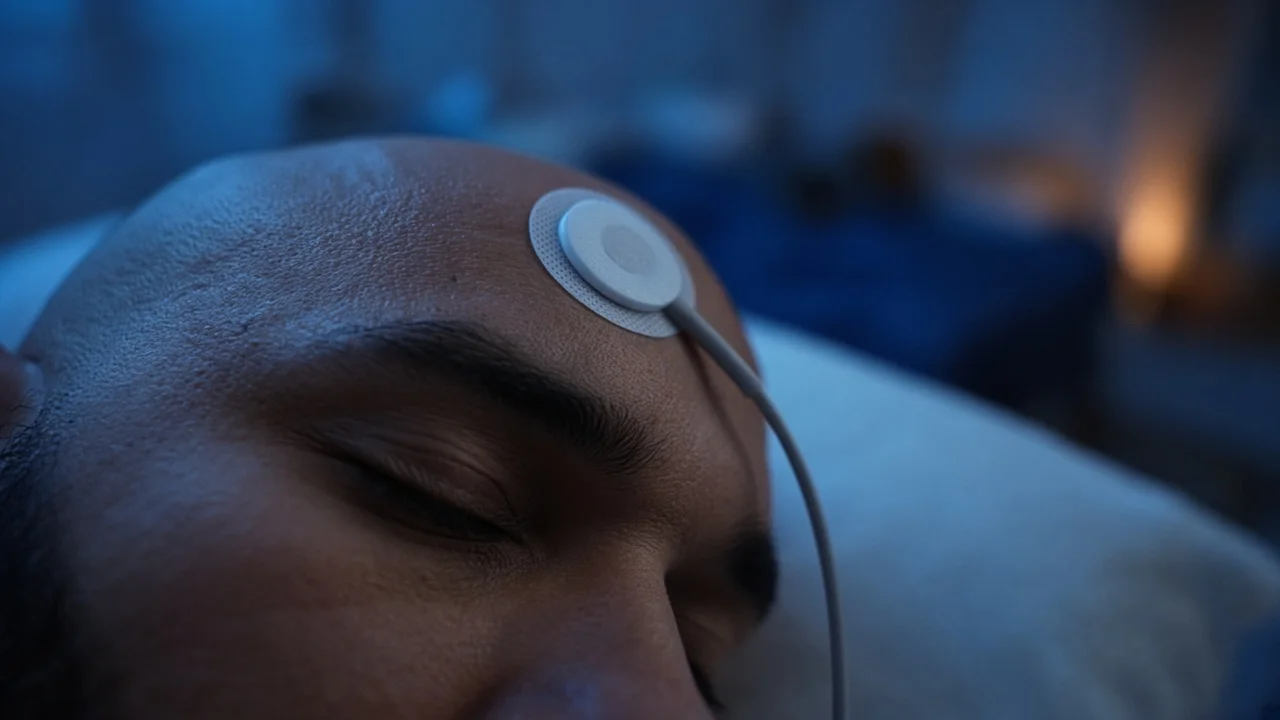
External trigeminal nerve stimulation (TNS) sends low-intensity electrical pulses through small sticky electrodes on the forehead. In this trial, young people wore the Monarch eTNS system, made by NeuroSigma, for about 8 hours a night while they slept, for four weeks.
The US Food and Drug Administration cleared the device for ADHD in 2019, based on a pilot trial of 62 children.
The trial in brief
- Who took part: 150 young people aged 8 to 18 (average age 12.6, 53 of them girls), split evenly between the real device and a sham. Around 39% stayed on their usual stimulant medication.
- The sham: an identical device that gave about 4 minutes of weak stimulation a night, compared with about 4 hours on the real one. The blinding worked.
- What was measured: attention, inhibition, timing and processing speed, plus heart rate, heart-rate variability and skin conductance from a wristband, and head movement from an eye tracker.
- When: at the start, after 4 weeks and at 6 months (the wristband measures at the start and 4 weeks only).
What it showed
There was no meaningful difference between the real and sham devices on any thinking or physical measure. The one exception was head movement at rest after 4 weeks, but that was the sham group moving more, it had gone by 6 months, and the authors say it could be down to chance. Children who weren't taking medication showed the same results.
On safety, there were no serious side effects, no difference in side effects between the groups, and acceptability was 82%.
Why it matters
Plenty of families would rather try something that isn't medication, and the paper notes that most people with ADHD prefer non-drug treatments. The same team reported earlier that the device made no difference to ADHD symptoms in this trial. This analysis adds that it didn't help thinking skills or the body's arousal system either, and the authors conclude their findings don't support TNS as a treatment for either in young people with ADHD.
It's also a good example of why sham-controlled trials matter. A device can be cleared on a small pilot study and then not hold up in a larger, double-blind trial.
Worth bearing in mind
For a negative result, this is fairly strong evidence. It was a large, carefully controlled trial, and 98% of participants were still in it at 4 weeks and 97% at 6 months. But there are limits:
- These were secondary outcomes, and the authors call several of the analyses exploratory.
- Only one stimulation setting was tested. Others might behave differently.
- The weak sham stimulation may not have been completely inactive.
- The wristband's skin readings are less precise.
- It only covers children and teenagers, not adults.
What happens now
This is research news, not advice. If you're thinking about any ADHD treatment, including devices, for yourself or your child, your GP or prescriber is the right person to talk to.
Rewritten for ADHDer from reporting by American Journal of Psychiatry. Originally published 28 Oct 2026.
Read the original at American Journal of Psychiatry ↗